
The Lee County Most Wanted Program
The Lee County Sheriff's Office publishes no searchable most-wanted roster. Its main page and its Online Resources page offer agency contacts and public systems, yet neither links a wanted-person list you can browse. Lee County Crime Stoppers is the county's official channel for this work. It takes anonymous tips about criminal activity and about where people wanted by police may be found. So the honest picture is program-level. A reader looking for names should treat the program as the source, not expect a standing roster the sheriff does not maintain. Nothing here reproduces names, photos, mugshots, or allegations, and no roster is hosted or copied. Those details change as cases change, and the agency or program that publishes them keeps responsibility for updating them. Check the official channels directly for anything current.
Lee County Most Wanted Tip Program
The official Lee County Crime Stoppers page lists telephone 319-376-1090 and links to P3 Tips for anonymous reporting. Tips can cover criminal activity, an identification, a wanted person's location, missing-person whereabouts, and other law-enforcement information. A cash reward is sometimes possible, though the county page publishes no amount or cap, so treat payment as never guaranteed. The program pairs citizen participation with law enforcement and distributes much of its public information through social media.
How the Lists Work
A most-wanted notice is a chosen public-information item, never a complete list of unserved warrants. An agency lifts one case up for public help, then pulls the notice back after an arrest, a surrender, a recall, or a change in the investigation. Lee County follows no fixed weekly or monthly update schedule. Iowa Courts Online works differently. It is a public docket index kept by clerk offices, not a certified active-warrant roster. The restricted IOWA System connects criminal-justice agencies and NCIC, but the public cannot self-search it.
Note: A public notice is a changing snapshot; absence from it never proves that no warrant exists.
Lee County Most Wanted Roster Boundary
No official page amounts to a complete Lee County most wanted list. Crime Stoppers describes its program and its public-information channels. The sheriff publishes contacts, records requests, and online resources. Neither promises a full roster, so treat any list you encounter elsewhere with care. A good civic reference links the official program and explains how to submit information without copying individual profiles. Names and photos go stale as cases change, and a copy can drop warnings, corrections, or agency contact instructions that matter. Always view any current notice at its official origin.
How to Report a Tip Safely
Use the tip channel only for information that could help law enforcement. Lee County Crime Stoppers is not the place to check your own warrant status or ask about a relative's court case.
- Use 319-376-1090 or follow the P3 Tips link from the official county page.
- Report useful facts such as location, time, vehicle, direction of travel, or other observed details.
- Do not approach, pursue, detain, photograph at close range, or announce the tip publicly.
- Use 911 for immediate danger; use official non-emergency or tip channels for other information.
Key Point: Report what you safely observed, then step back and allow trained officers to assess and respond.
Lee County Most Wanted Status Uses the Clerk
For your own status, search Iowa Courts Online and call the right Lee County clerk: Lee North at 319-372-3523, Lee South at 319-524-2433. Ask whether the docket shows an active arrest or failure-to-appear warrant, which court issued it, and what process that court requires. The sheriff general office is 319-372-1152, the jail is 319-376-2355, and non-emergency dispatch is 319-372-1310. The official site lists no dedicated warrant number. Call first and ask about current surrender, booking, identification, bond, and property rules.
Most Wanted vs an Active Warrant
The two ideas overlap only when an agency chooses to publicize someone tied to an active warrant. Most Lee County warrants never become a most-wanted notice. A court case can also have public docket events without ever appearing in a social-media post.
| Feature | Most-wanted notice | Active warrant |
|---|---|---|
| Scope | Selected public-information item | Any warrant not served, recalled, quashed, or otherwise closed |
| Public source | Agency or Crime Stoppers channel, when published | Court docket plus clerk and law-enforcement confirmation |
| Purpose | Seek public information | Authorize enforcement under court terms |
| Change | Post may be removed or updated | Status changes through service or court action |
Lee County Most Wanted Posts and Dockets
Crime Stoppers says most of its public-information activity runs through social media. Those posts can carry current program announcements, but they are not court records, and nothing publishes a refresh schedule for them. A docket is a clerk-maintained index of case events, yet even it may not display every operational warrant. The Lee County Sheriff's official page holds the agency's current contacts and service links. Use an agency post only for its stated purpose. For direct confirmation in Lee County, go to the clerk or the sheriff. If the answer shapes a planned surrender or court action, counsel can contact the issuing court and coordinate the next step.
Lee County Most Wanted Scam Warning
Scammers may claim an arrest warrant, jury problem, or fine demands immediate payment by gift card, cryptocurrency, prepaid card, text link, or a special call-in number. The Iowa Judicial Branch warns that real court communications never make those demands. End the contact. Then find the court or sheriff number yourself on an official Lee County page. The official Judicial Branch scam warning lays out the red flags.
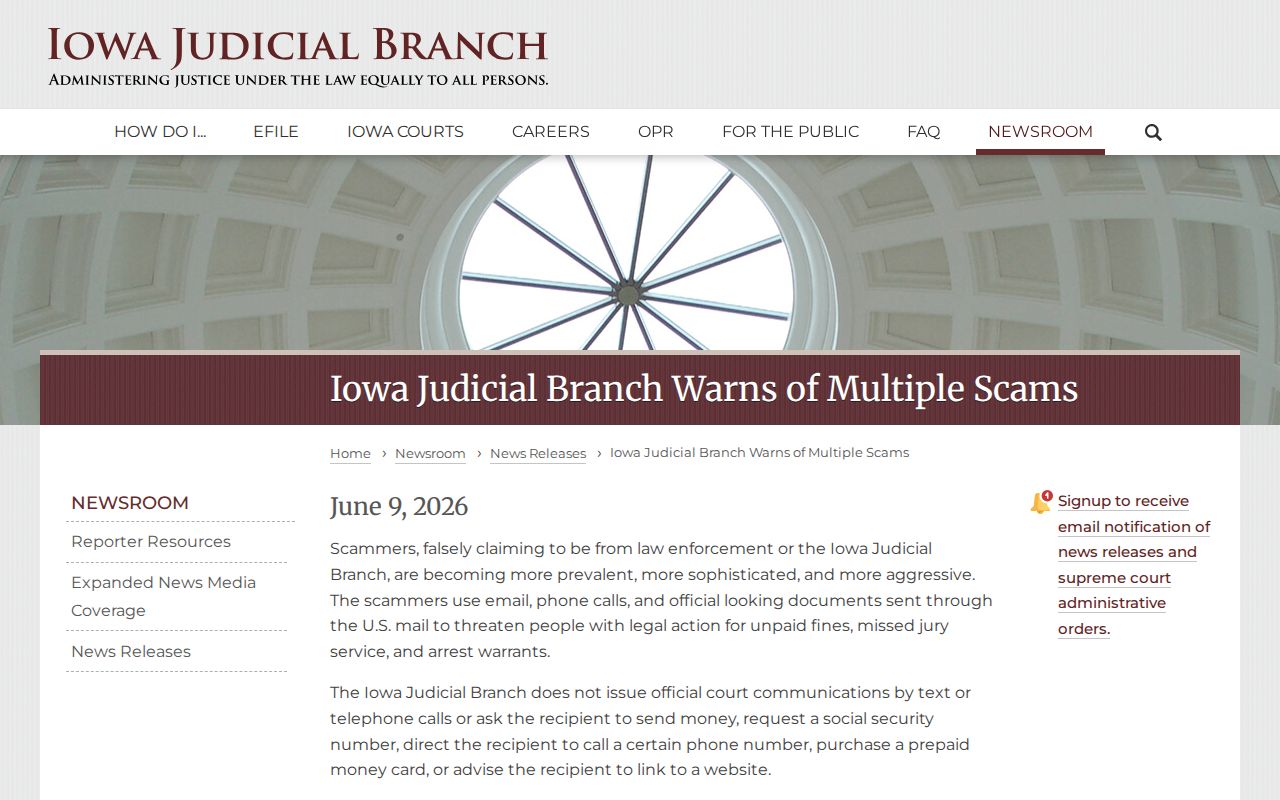
The warning helps Lee County residents tell a genuine clerk confirmation from coercive messages fishing for money or personal data.
If You Believe You Are on a List
Crime Stoppers is the wrong place to sort out your own situation. Use it to report, not to negotiate or confirm your status. Start with the Lee County case docket, then reach the right clerk or an attorney. Ask flat out whether a warrant is active. Get the issuing venue, the underlying case, the bond amount, and the steps the court requires. A lawyer can request a new appearance, file the right motion, or arrange a surrender with bond already lined up. If the clerk sends you to law enforcement, phone the jail or the sheriff before you walk in. Lee County publishes no walk-in warrant-clearing schedule, no recall form, and no amnesty event, so promise yourself no particular outcome or timing.
Important: Confirm through counsel and official offices; do not arrange a confrontation or rely on an unofficial copied list.
Lee County Tips Are Not Case Searches
A tip line has one job. It gathers information for law enforcement to assess, nothing more. It cannot tell a caller whether they, a relative, or anyone else has a warrant. It cannot explain bond, set a hearing, take a court payment, recall a warrant, or fix a docket. Those questions belong with Lee North, Lee South, the Sheriff's Office, the jail, or your counsel, depending on the case. Keeping the channels apart protects both the program's purpose and the accuracy of the answer. Have a case question? Hand the clerk a citation or case number and ask about the public docket. Have information useful to police? Use the anonymous program. Facing immediate danger? Call 911. The line between them keeps an emergency from being delayed and a court inquiry from disappearing into a tip queue in Lee County.
Lee County Most Wanted Information Changes
Public-safety postings move fast. An arrest, a surrender, a court recall, a corrected identity, or a shift in the investigation can change a notice after it goes up. Lee County publishes no fixed refresh schedule, so check the official source as it stands now; this page preserves no individual entry. Absence from Crime Stoppers social media proves nothing about warrant status. Most warrants are never picked for a public post at all. A docket can list a case without any simple active badge. Status has to come from the issuing clerk, and when needed from the sheriff, the jail, or the enforcing police agency. A good tip sticks to what you actually saw. Location, time, a vehicle description, direction of travel, and the conduct involved all help officers. Rumor, guesswork, and endless resharing create risk instead. So does playing detective. Never enter private property, tail a car, provoke a confrontation, or try to detain anyone. Immediate danger means 911, not a non-emergency line. On rewards: the Lee County program says they are sometimes available but names no guaranteed sum. Keep your anonymous reference number private and follow the program's instructions. Don't post that number where others can see it, and don't repeat identifying claims from a personal account. The program and law enforcement decide how a tip is assessed, whether public notice fits, and whether reward conditions were met.