
How to Check for a Warrant in Lee County
Iowa Courts Online is the free public entry point for a Lee County warrant check. The state index, kept by Iowa clerk offices, is not a complete list of active warrants. Before searching, gather the full name used in court, a case or citation number if you have one, the approximate date, and the likely North or South venue. A citation number works well for a traffic matter, and a case number beats a common name. A birth date helps an official sort out similar names, though sensitive details should wait until the clerk actually asks for them. Use each available channel in turn. Confirm with a live office before paying a fine, showing up, or trusting a blank result.
- Search Lee County in Iowa Courts Online by case number, citation number, or name. Read the docket for an appearance, warrant, bond, return, recall, or disposition event.
- Call Lee North at 319-372-3523 or Lee South at 319-524-2433, based on the venue shown in the case.
- For service, custody, or surrender routing, call the sheriff at 319-372-1152, jail at 319-376-2355, or non-emergency dispatch at 319-372-1310.
- If the docket is not enough, submit a narrow sheriff records request for the specific record or status sought.
- If a warrant is confirmed, ask the issuing court and an attorney what appearance, motion, payment, bond, or surrender step applies.
Iowa Courts Online and Lee County Warrants
The search entry gives the controls used for Lee County cases. Pick the county first. Then search with the strongest identifier you have, because a case number is far less ambiguous than a common name, and a citation number fits a traffic or scheduled-violation matter. Judicial Branch help outlines the charge choices, including traffic, simple or criminal, and civil infraction. The official page at the end of this section is that case-index entry point. It opens a route to docket information for a Lee County warrant search, not a sheriff-certified roster of active warrants.
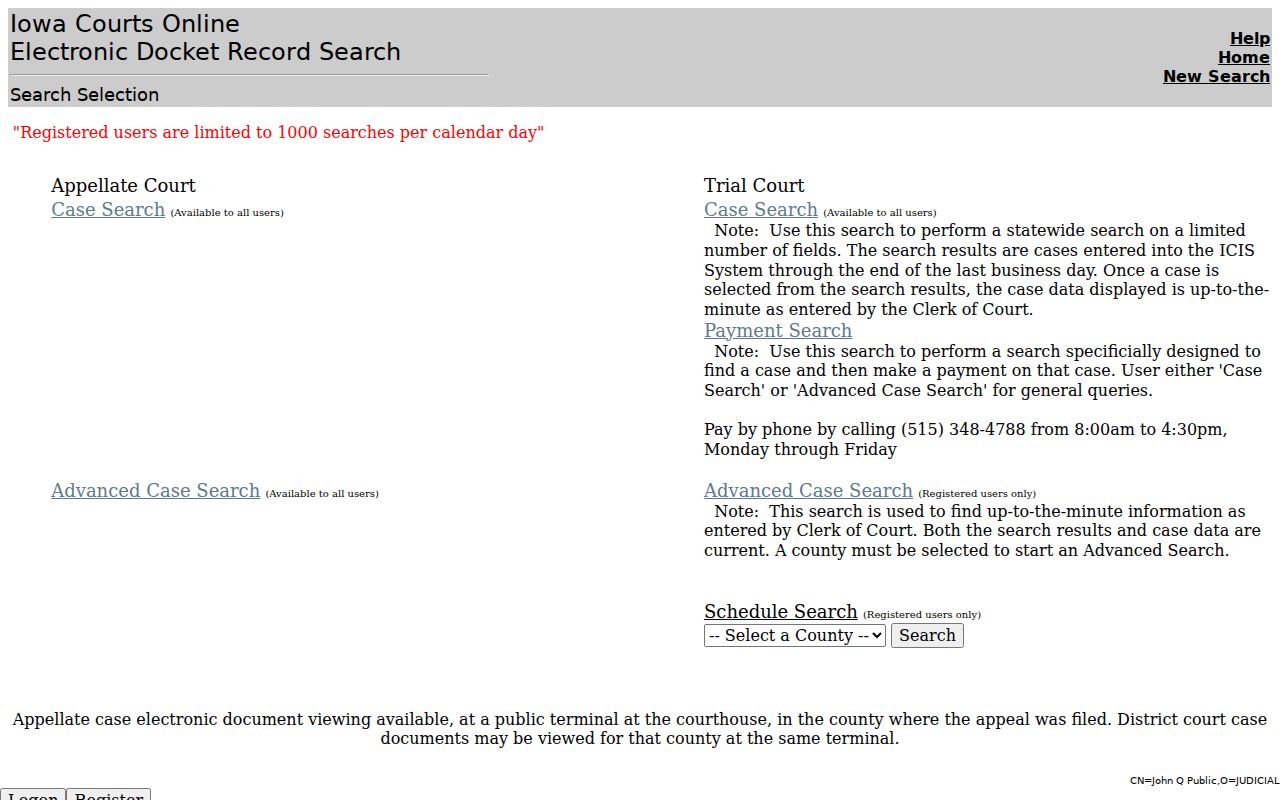
A match can show filed events and reveal which Lee County venue holds the case. No match is not the end. Posting delays, spelling differences, a sealed matter, juvenile confidentiality, or an event not exposed as a simple public result can all hide a case.
| Search input | Best use | Limit |
|---|---|---|
| Lee County | Places the query in the local docket | Does not choose North or South alone |
| Case or citation number | Targets one known file | Exact warrant format is not published |
| Name | Works when the number is unknown | Similar names need clerk confirmation |
| Charge type | Narrows case context | Does not prove warrant status |
Types of Warrants in Lee County
Iowa runs a unified district court rather than separate municipal courts. The real distinction for a Lee County warrant is the legal reason behind it. A warrant tied to a city citation still gets filed and heard in Iowa District Court. Search warrants follow a different process from the arrest-related records people usually want.
| Warrant type | How it arises | Who issues it |
|---|---|---|
| Arrest warrant | A complaint and facts establish probable cause | An Iowa judicial officer |
| Failure-to-appear warrant | A required court appearance is willfully missed | The court handling the case |
| Bench warrant | A court-related nonappearance or noncompliance | A judge or magistrate |
| Traffic warrant | A citation reaches a missed required appearance | The district court |
| Search warrant | Probable cause supports a search for evidence | An authorized judicial officer |
The statutory phrase in Iowa is failure-to-appear arrest warrant. Bench warrant is plain language that still fits when a Lee County docket or court uses it. Capias and capias pro fine are not official terms here.
Why Lee County Has Two Warrant Clerks
Lee County has a court setup most Iowa counties do not: two venues tracing back to the First General Assembly and the county's size. Lee North sits in Fort Madison, and Lee South sits in Keokuk. These are not rival courts or separate systems. Both are locations of Iowa District Court in Judicial District 8, each with a clerk who keeps the docket and case files assigned to that venue. Read the case location before you call. Lee North's clerk page lists 701 Avenue F in Fort Madison and 319-372-3523, while Lee South's clerk page lists 25 North 7th Street, Suite 301, in Keokuk and 319-524-2433. Both pages note security screening, a weapons ban, and limits on recording devices. The right Lee County clerk can interpret a docket event and explain which court controls the next step in the case.
What a Lee County Warrant Record Shows
Lee County does not publish a local warrant-card format, so the case or citation number is the stable cross-reference. Iowa Code section 804.2 sets the core fields an arrest warrant must carry. A public docket may also show bond, service, return, or disposition events. The exact label the court uses matters.
| Case or citation number | The public cross-reference, shown here only as case number; no sample local format is invented. |
|---|---|
| Person | The defendant's name, or an unknown-name designation allowed by law. |
| Offense | The offense name or general description and, when shown, its code or class. |
| Issuing place | The county or city, judicial officer, and North or South venue. |
| Issue date | The date the warrant was signed or entered. |
| Bond and status | Any order or condition plus issued, served, returned, recalled, quashed, or disposed events. |
A Lee County Docket Is Not a Warrant Certificate
The Judicial Branch describes Iowa Courts Online as an electronic docket index, not a promise that a name search equals a full active-warrant check. Fresh citations often need 10 to 14 days or longer to post, especially around weekends or holidays. Sealed matters, juvenile records, ongoing investigation material, a recent warrant, and name mismatches can each keep an expected event out of view. The official docket and payment landing page explains the public case route and points people to a clerk when the online answer is not enough for a Lee County warrant question.
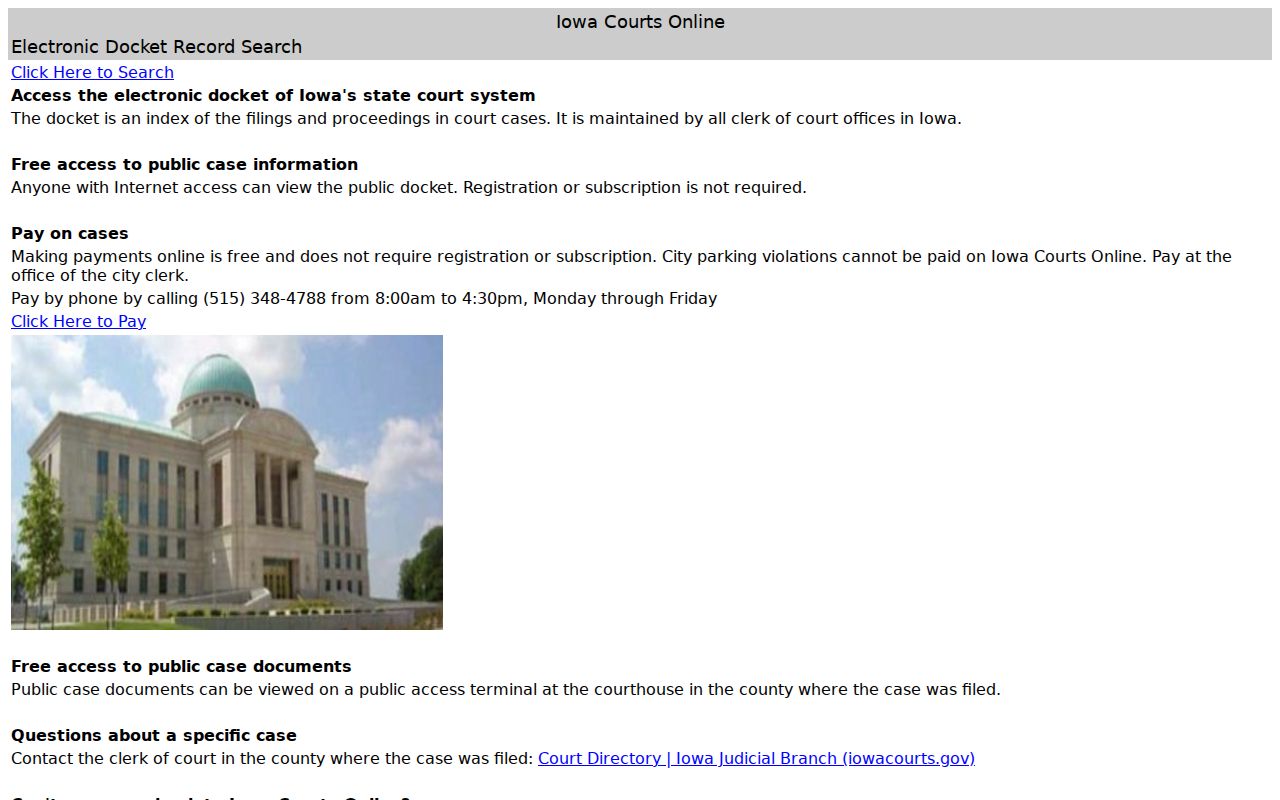
Use a docket result to locate the case and its clerk. Then ask whether the warrant is active, served, recalled, quashed, or replaced, and get the date and the office responsible for the status update. Note: An empty search is a reason to work the clerk and sheriff fallback chain, not proof that no Lee County warrant exists.
Who Issues and Serves Lee County Warrants
District judges, district associate judges, and judicial magistrates all act within Iowa District Court according to their jurisdiction. Courts issue warrants. The clerk records each order and maintains the case file. Iowa Code section 805.5 explains how a failure-to-appear warrant and its citation pass through the clerk and return to the issuing agency for enforcement. On the service side, the Lee County Sheriff's Office, city police, Iowa peace officers, and sometimes federal partners can serve warrants. The sheriff site does not list a separate public warrant division or searchable roster.
Lee County Sheriff's Office and Jail
2530 255th Street
Montrose, IA 52639
Sheriff: 319-372-1152
Jail: 319-376-2355
Dispatch: 319-372-1310
Office hours: Monday through Friday, 8 a.m. to 4 p.m.
Warrants in Lee County come from the courts, and questions about them get routed by the sheriff's office. The Lee North and Lee South clerks keep the dockets that show what a court has done. A phone call to a clerk or sheriff cannot change a court order.
Which Lee County Sheriff Number to Call
The Lee County sheriff page posts three helpful numbers, though none is promised as a dedicated warrant hotline. For general routing, call the main office and ask whether warrant status can be confirmed over the phone. For custody, booking, bond, or a surrender procedure, call the jail. Non-emergency dispatch works when you are unsure which agency handles the issue. A routine warrant check never belongs on 911.
Those routes cover the office, jail, and dispatch. They do not establish walk-in surrender hours, a bond window, or a public warrant counter in Lee County, so verify such details before you travel.
What to Do If You Have a Lee County Warrant
Start by identifying the issuing case and venue. Ask the clerk why the Lee County warrant is still active. Find out whether the court wants a new date, payment, a motion, counsel, a personal appearance, or surrender. If contact with law enforcement is required, call the jail or sheriff before you show up. Ask about intake hours, identification, property rules, the actual bond amount and accepted form, and whether a lawyer can coordinate the process. Paying court debt is not the same as a recall. After any payment, appearance, booking, bond, or court order, get a receipt or docket entry. Then confirm status with the clerk and the agency involved. The Lee County arrest-warrant process explains why bond or release does not end the underlying case.
Important: Speak with an attorney and issuing clerk before surrendering because Lee County publishes no universal walk-in or warrant-recall procedure.
Court Debt and Lee County Warrant Status
Iowa court debt can include fines, surcharges, restitution, and costs. The Judicial Branch takes eligible payments online, by mail, at the clerk counter, or through its payment center. A traffic payment can count as a guilty plea unless the citation requires a court appearance. None of that proves a related warrant was recalled. The official Iowa court payment interface locates debt by case, citation, county, charge, or name.
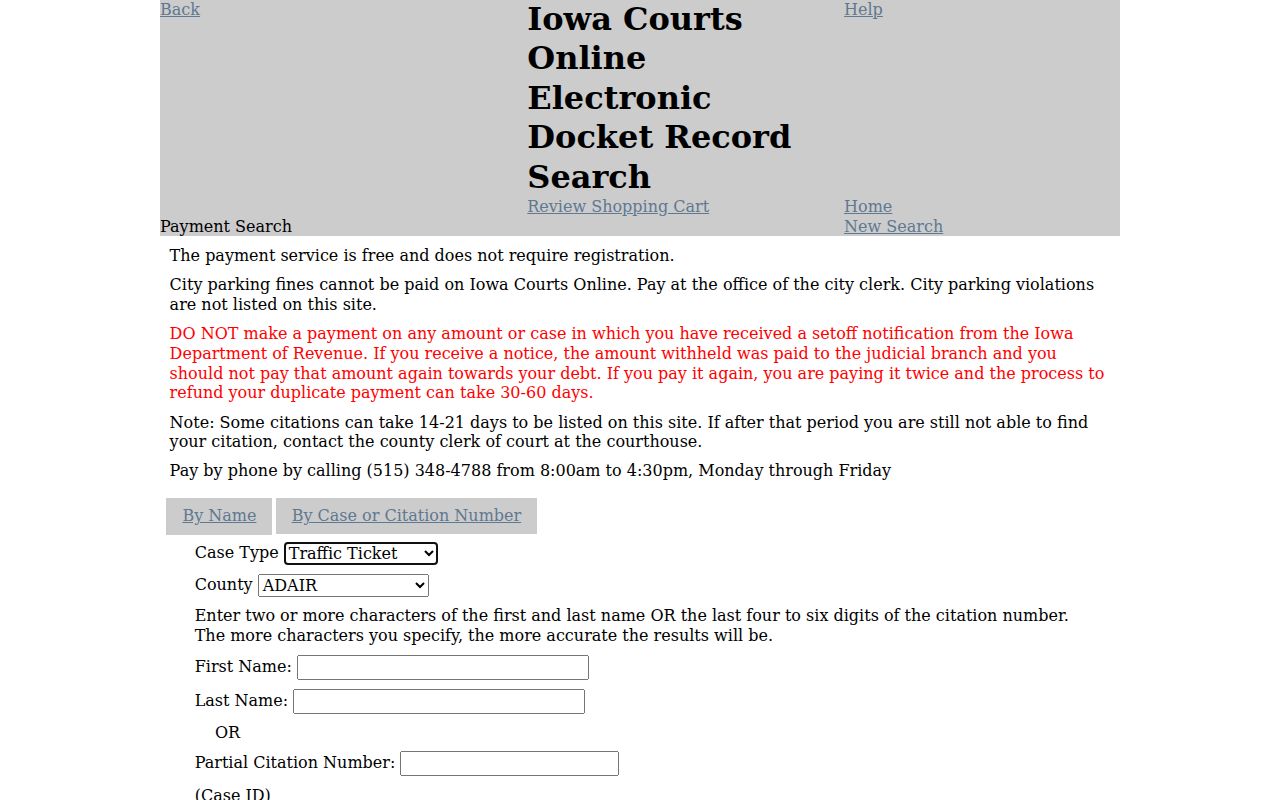
Use that screen only when the clerk says payment is part of resolution. Save your proof, then ask whether the Lee County warrant event changed and whether notice reached the issuing agency.
| Action | What it can do | What still needs confirmation |
|---|---|---|
| Pay court debt | Satisfy an eligible balance | Whether a warrant was recalled |
| Post bond | Secure release and appearance | The next date and case status |
| Appear or file a motion | Put the issue before the court | The signed order and agency update |
Public Access to Lee County Warrant Records
The Iowa Open Records Law and court-access rules allow broad access, yet not every warrant item becomes public. A defined request can seek a copy or a status record from its custodian. Investigative reports, criminal-identification files, juvenile records, sealed matters, and other protected material may be withheld. So a Lee County request can come back with less than you hoped for.
Key rules:
Iowa Code §22.2 gives every person the right to examine and copy public records unless another law creates an exception.
Iowa Code §22.7 protects specified investigative and identification material while treating current and prior arrest and criminal-history information as public categories.
Iowa Code §232.149 makes juvenile delinquency and juvenile-justice records confidential, subject to exceptions.
Iowa Code §804.2 lists the core contents required in an Iowa arrest warrant.
Requesting Lee County Warrant Records
When the docket and phone calls fall short, turn to the sheriff's records-request instructions. The form has requester fields plus open text for any other records. Describe a narrow request. Include a known case or citation number and an approximate date, and say whether you want current status or a copy. Avoid sending extra personal data unless a custodian asks for it. The first 30 minutes of preparation are free. Added work may be billed, printed or faxed pages cost $1 each, and a CD, DVD, or flash drive costs $5. Email can waive the paper or media fee. Ordinary processing runs within 10 business days. Confidentiality review can take up to 20 calendar days, and larger Lee County requests can run longer. Payment is due before release. Note: A records response shows what an office holds, but only the issuing court can recall or quash a warrant.
Lee County Warrant Terms in Plain Language
Iowa terminology can create false assumptions about a Lee County warrant. The statutes usually say arrest warrant or warrant for failure to appear. A public docket may apply a bench-warrant label to a missed court duty. Ask the clerk for the exact event and its current status.
- Failure to appear
- A willfully missed required appearance that can lead to an arrest warrant.
- Bench warrant
- A common description for a judge-issued warrant tied to nonappearance or noncompliance.
- Active or outstanding
- A warrant not shown as served, recalled, quashed, or disposed of, subject to confirmation.
- Recalled
- The issuing court withdrew the warrant.
- Quashed
- The court set the warrant aside by order.
- Returned
- The warrant or citation went back to court after service or other action.
Lee County Warrant Scams and Safe Checks
A caller may claim an arrest warrant, traffic fine, or jury matter demands immediate payment. Hang on before you act. The Iowa Judicial Branch scam warning says courts never use calls or texts to demand prepaid money, personal information, or a required callback number. End the contact and use a number from the court directory or county page. Never send a gift card, cryptocurrency, or rushed payment because a caller threatens arrest. Call the right Lee County clerk and ask whether the docket shows the event. If the concern involves service or custody, use the published sheriff or jail number. That separate check tells a real court duty apart from a panic-driven demand in Lee County.
The Restricted IOWA Warrant System
IOWA System stands for Iowa On-line Warrants and Articles. It is not a resident-facing lookup. The Iowa Department of Public Safety describes a network linking more than 450 police, sheriff, state, and federal criminal-justice agencies with NCIC. Only authorized agencies hold access. For a public Lee County search, use Iowa Courts Online and official clerk, sheriff, jail, dispatch, or records-request channels. A court docket and this restricted network serve different purposes. Agency data creates no public login, and absence from a public docket does not prove there is no warrant.
Warrant Records by City in Lee County
City police in Lee County can write citations and serve papers, but they do not run their own warrant dockets. There is no municipal court here. Instead, a city citation gets filed with the district-court clerk under Iowa Code section 364.22. An Iowa District Court judicial officer then hears the case. Each city page in Lee County starts with that city's police and records route, then points you to the right district-court venue.
Fort Madison Warrant Records
Population 10,270 · Police records and Lee North clerk route.
Keokuk Warrant Records
Population 9,900 · Police contacts and Lee South court path.
West Point Warrant Records
Population 921 · Local police with a county sheriff connection.
Donnellson Warrant Records
Population 885 · LeeComm-first routing and city records access.
Montrose Warrant Records
Population 738 · City Hall, sheriff, and jail roles.